

Match odds within an accumulator bet can change whenever unexpected situations occur. Before reviewing resolution criteria, it is important to understand what is an accumulator bet. In simple terms, it refers to combining multiple choices into a single voucher, where the final outcome depends on the resolution of every choice under defined requirements. When a voucher includes a suspended match—whether delayed or voided—international standards apply specific adjustment methods to protect player rights. This article therefore summarizes the core calculation principles, helping you interpret bet state correctly and verify final conclusion outcomes with confidence.
Understanding “suspended matches” in bundler bets halted vs cancelled
When interpreting a “suspended match” in a parlay context, focus on contest state, not the details of Sports rules, because these statuses directly affect how match odds are settled on your voucher. In general, they fall into two categories:
- halted: The match odds still has a chance to be played but is moved to a different date or time. The receipt remains pending, and conclusion can proceed if the contest is eventually match finished under the requirements stated on the card.
- Cancelled: The match produces no cricket match results that can be used for standard clearance—such as when a match is not played or no official outcome is recorded for Cricket betting. In online cricket betting, this usually leads to a state adjustment on the receipt (for example, refund/void/removal), with the remaining choices recalculated accordingly.
Clearly separating these two terms helps you anticipate clearance outcomes more accurately: delayed means waiting for a result, while voided means there is no result to settle in the usual way.
Finalization Standards For Postponed Selections The “Completion Timeframe” Rule
When a choice in a parlay bet is deferred, a commonly applied principle is that the encounter must be match finished within the timeframe specified on the card or by the operator for the system to use the official outcome to settle Cricket betting. This point is critical for protecting player rights, because different slips may reference different sub-rules based on the criteria attached to each individual form.
In practice, finalization guidelines usually work as follows:
- If the adjourned clash is rescheduled and completed within the stated timeframe:
The system typically uses the official result of that fixture to settle the receipt as normal. - If the adjourned clash is not played, or is not completed within the stated timeframe:
The system may adjust the docket according to the provisions—such as issuing a refund, marking the alternative as void, or removing it from the bet—then recalculating betting results based on the remaining options.
For this reason, when you encounter a deferred position, the correct approach is not to guess the number of hours involved, but to check the exact timeframe written on the form, as that rule determines how determination will be applied.
Match Odds when a preference is cancelled how void, refund, and removal work in aggregate bets
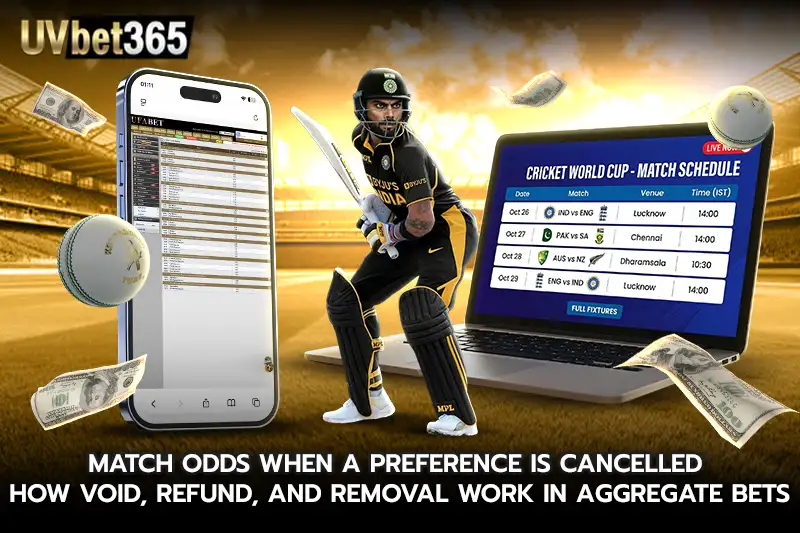
An annulled fixture means there are no cricket match results available for standard determination. As a result, the system usually handles this situation by adjusting the bet position to keep determination fair for the player. In most cases, the affected alternative is treated as neither a win nor a loss, but instead shifted to a level specified on the record—such as a refund (often shown as void/null) or removal from the parlay.
Once a preference is annulled, the combo is recalculated from “multiple options” down to only those fixtures that still have valid outcomes. The system then settles the docket again based on the remaining components. This explains why the overall meeting odds of the entire bet may be recalculated. A similar mechanism applies when wagering under Cricket odds, where pricing can adjust according to real meeting level rather than fixed numbers, because final closure always depends on the provisions attached to the label and the operator’s rules.
A rescheduled or cancelled candidate does not automatically mean the combo loses—the correct reference point is always the stipulations displayed on the bet docket itself.
Match Odds in aggregate bets how the entire slip is adjusted when a selection is postponed or cancelled

The core principle is simple: the system looks at bout progress and follows one of two paths—
(1) use the final result when the fixture is played and completed under the stated stipulations, or (2) adjust the progress of any candidate that has no valid outcome (for example, refund/void or removal), then recalculate the stub based on the remaining options.
This logic applies across all sports, including cases involving Cricket betting.
Status summary → impact on the token
- stalled + completed within the label clauses: The system uses the official cricket match results to settle that nominee, and the combo continues as normal.
- stalled but not played / not completed within the label clauses: The affected nominee may be set to refund/void or removed, after which the stub is recalculated using the remaining alternatives.
- Cancelled: The listing is usually treated as having no win–loss impact (such as refund/void or removal), and the stub is recalculated from the fixtures that still have valid outcomes.
This mechanism explains why interpreting Cricket odds (when the chit involves cricket markets) or the overall pricing of a bundle can change. The odds and structure ultimately reflect only the alternatives that remain eligible for closure.
Checklist before confirming a slip where to look to know how a suspended assortment will be settled
From the perspective of cricket betting tips, the most important way to avoid mistakes is to fully review standing + note parameters before accepting confirmation. To protect your rights as a player, use the checklist below to determine how a suspended listing will be handled on your chit:
- Check the duel phase shown on the note Abandoned: The tie started but could not be completed → usually treated as “no standard outcome” and resolved as void or removed according to tag parameters. Suspended: Play is temporarily halted and later resumed → functionally similar to shelved, meaning the system waits for completion within the timeframe specified on the tag.
- Read the proof parameters carefully: Focus on sections that mention refunds, void phase, or removal of alternatives (often found in market details or bet rules).
- Look for any referenced window on the proof: Always follow what is written on the pass, rather than assuming a fixed number of hours.
- Review the total number of entries in the bundle: Identify which ones are affected—for example, if a cricket market using Cricket odds is shelved—to assess how many entries remain eligible for confirmation.
- Check the updated pass standing after the incident: Confirm whether the system applies a refund, adjusts the bet structure, or keeps the pass pending.
This checklist does not help you win—but it ensures you fully understand your rights within the ticket before accepting the final settlement.
Summary match odds in aggregate bets—understanding suspended listings to protect player rights
A bundle bet wins only when every assortment is settled. When a fixture is shelved or scrapped, the system relies on the permit conditions to adjust stage and recalculation—such as using the final result if the tie is completed within the referenced window, or switching to refund/void/removal when no standard result is available. The safest approach is to always review duel stage + permit conditions in full, so you can protect your rights and interpret match odds correctly.